Wi-Fi Data Offloading and Edge Computing for Greener Mobility Services
Download PDF
Abstract
To leave a healthy planet for future generations, it’s necessary to respond to environmental considerations like carbon neutrality, energy efficiency, and the circular economy when we design new solutions. At the same time, service providers must answer the demands of users who want transportation that is safe, comfortable, and efficient — demands that would normally require increased energy consumption. Thankfully, technological advancements can sometimes provide ways for engineers to balance competing demands like these. The team’s approach to green mobility for this AECC proof of concept (PoC) is the optimization of mobility and energy flows through the use of digital technologies to reduce energy consumption. In the AECC PoC “Using Opportunistic Data Transfer for Connected Vehicles to Reduce Cell Congestion in Existing Mobile Networks,” we learned that opportunistic data transfer (ODT) works to help manage intensive data loads. We also know that we can update complex mobile service systems like HD maps at scale, thanks in large part to edge computing, from the “Enabling Distributed Edges for HD Mapping” PoC. This PoC takes further steps to evaluate the effectiveness of Wi-Fi data offloading and edge computing in mitigating network and cloud load. The study demonstrated that Wi-Fi network services could be used to transfer data, and that processing of data via small and large edge networks would not only work, but it would also save energy.
Business Strategy
One of the ways to meet user demands is to constantly update mobility services through digitalized or software-defined vehicles. This type of vehicle owes many of its features and functionality to the software, as opposed to the solely hardware-determined capabilities of traditional vehicles. The problem, however, is that this expanded capability is accompanied by a drastic increase in the amount of data (in other words, more vehicles x more data). Further, if vehicles are connecting to the cloud using cellular connections only, the load on the network and cloud would increase monumentally. According to industry estimates, the mature connected vehicle ecosystem will need to transfer up to 10 billion gigabytes of data to the cloud each month, vastly more than networks can handle today. As a result, the energy required for this would also be enormous. In other words, the team recognizes the challenge of greening and optimizing energy to handle the ever-increasing amount of data that mobility services would require.
Objective
This PoC evaluated the effectiveness of mitigating a load and reducing energy consumption on the network and the cloud. In particular, the study wanted to look at using Wi-Fi and distributed (edge) computing at roadside facility infrastructure for vehicle data offloading.
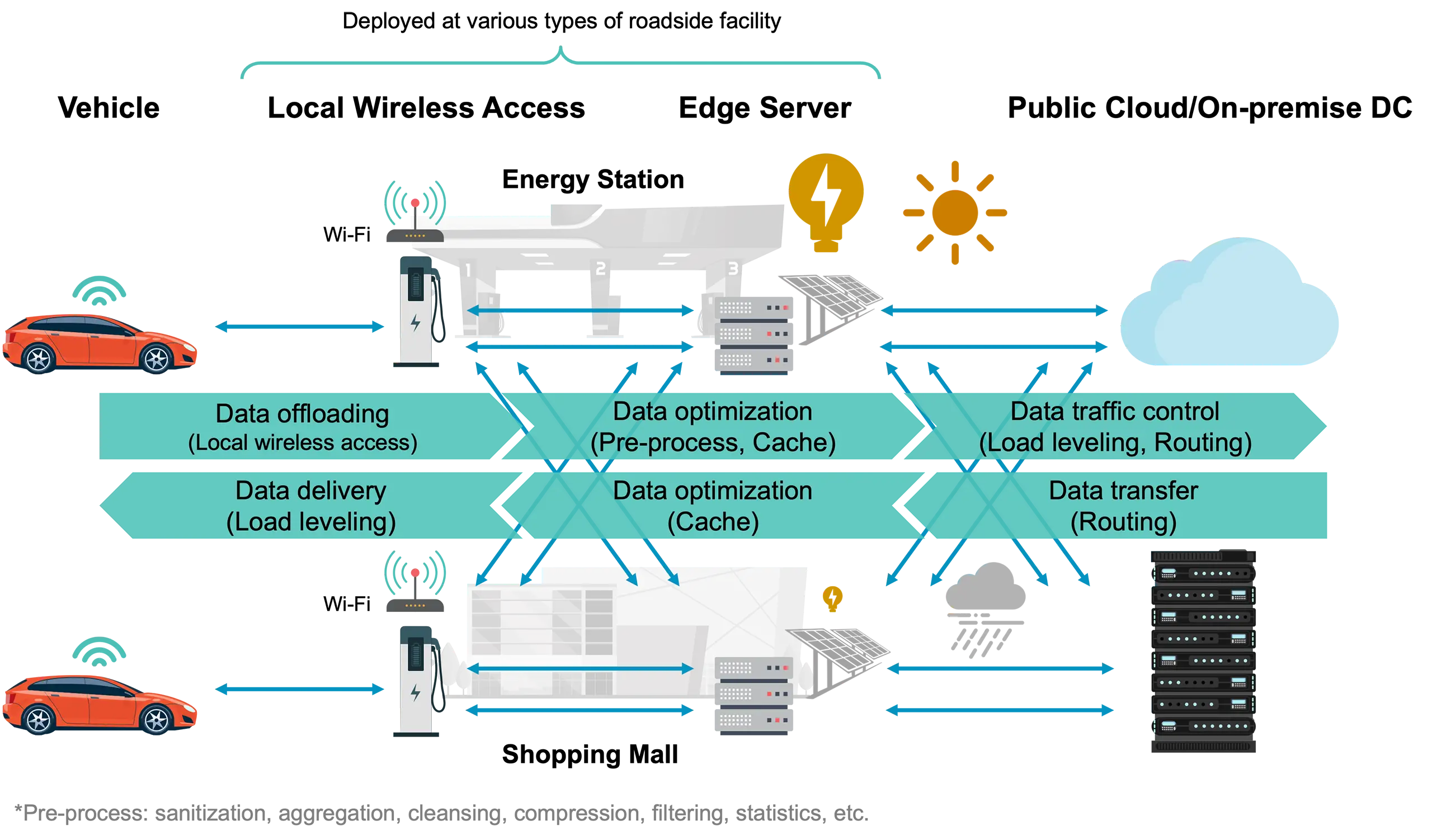
The PoC team hypothesized that carrying out pre-processing* at a roadside facility (such as a gas or charging station) instead of transferring data from the vehicle directly would allow the use of additional technologies and approaches that would save energy.
Scenario
A prototype minimum viable product (MVP) was built, and the team evaluated how much the load and energy consumption of the network could be mitigated using a process that simulated the following workflow:
- Vehicles would connect to a local wireless access point, such as Wi-Fi at a roadside facility, for data offloading. (For this phase, the data used was generated by software.)
- The offloaded data was pre-processed* at an edge server located at the facility to mitigate network and cloud load — effectively reducing the amount of data to be transferred and stored.
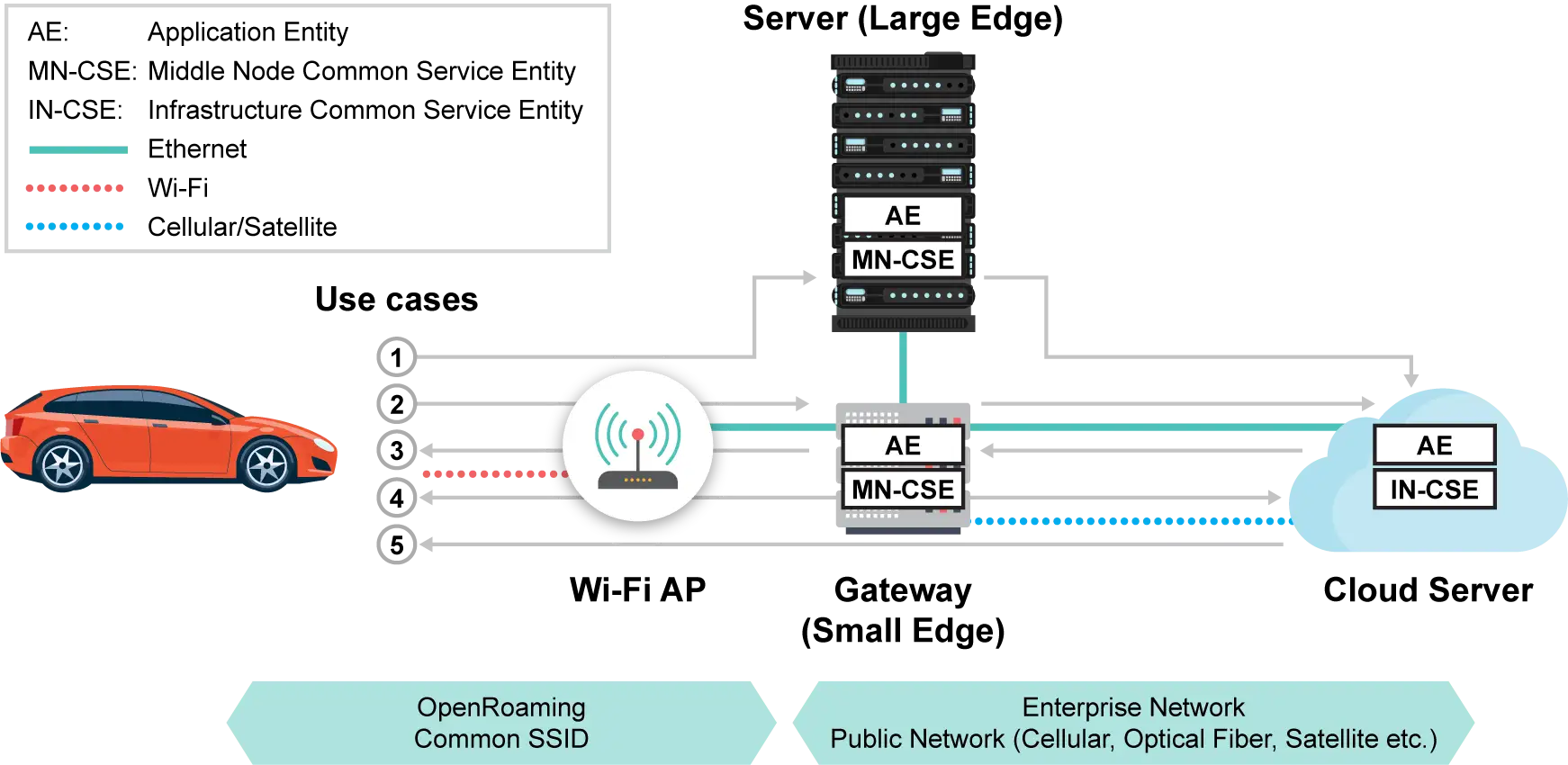
- The Gateway (small edge) was equipped with a CPU and up to several GB of storage and provided light data processing, cache, advanced routing, and other functions.
- The server (large edge) owned sufficient computing resources, including a GPU and large storage capacity, to perform pre-processing*, including high-load data processing and temporary storing of large amounts of data.
- Pre-processing* would be powered by green energy (e.g. solar power generated at the facility) as much as possible.
*Pre-processing includes sanitization (such as deleting private data like people’s faces or vehicle license plates), aggregation (such as eliminating duplicate data), cleansing, compression, filtering, and statistics compilation. A test was completed for each of the following use cases:
- Upload video image data from an autonomous-driving vehicle to an edge via Wi-Fi. The data would be pre-processed* and cached at the edge, then sent to the cloud during an ideal time window (for example, at night when there is less data traffic).
- Upload battery data (bulk data, raw data, etc.) from the electric vehicle to an edge via Wi-Fi, pre-process* it, cache the data, then send the data (metadata, smart data, etc.) to the cloud during an ideal time window.
- Synchronize in-vehicle applications with cloud services via Wi-Fi.
Technologies used included:
- Distributed computing architecture or edge computing, in which processing occurs or information is accessed via a local machine instead of directly from the cloud.
- Access network selection. This is the process by which a device connects to a wireless access network.
- Provisioning, or the allocation of resources to a request.
- Configuration update management to keep all devices current.
- Opportunistic data transfer (ODT). ODT enables non-time-critical traffic, such as software updates, to transmit during non-busy hours.
- AI was one of the essential technologies for this PoC, and it was used to analyze images from in-vehicle cameras and surveillance cameras installed in roadside facilities. The AI could mask information, such as a person’s face or a license plate number, to preserve privacy. It was used to improve security and safety by detecting vehicles or analyzing pedestrian behavior to avoid collisions.
- The Wi-Fi signal strength, or in other words, the Wi-Fi communication coverage area, was assumed to be within a radius of several tens of meters, since the system is designed for use at facilities where vehicles stop, such as gas stations. For example, if 1GB of software is downloaded at a gas station during a 5-minute refueling period, the speed would be 27Mbps/unit (1000MB/300sec = 3.3MBps = 27Mbps).
Results
Summary
This PoC successfully demonstrated that connecting with Wi-Fi and OpenRoaming would work seamlessly. It also demonstrated two options for processing (small edge and large edge), and proved that significant energy savings could be gained through data mitigation.
Energy Savings
Using an immersion cooling container data center (DC) at the edge resulted in a 94% reduction in facility power (including air conditioning), and a more than 50% reduction in total power (including equipment power) compared to a conventional DC (assuming 10 KVA per air-cooled rack).
Connecting
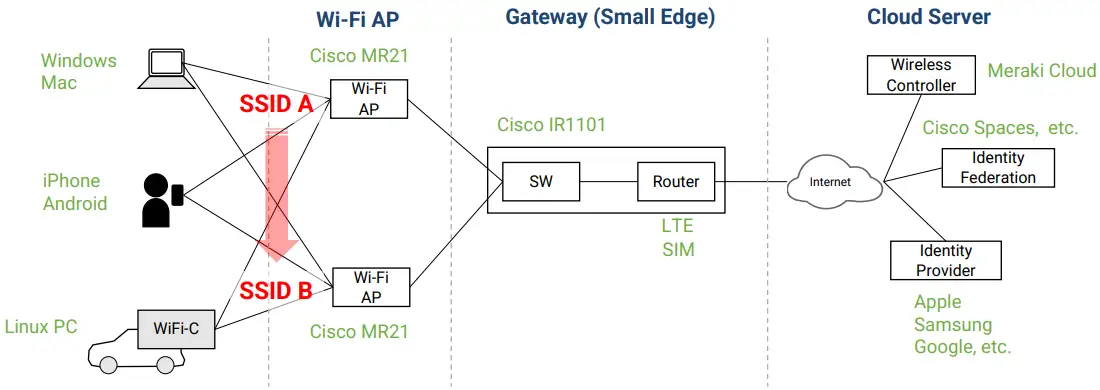
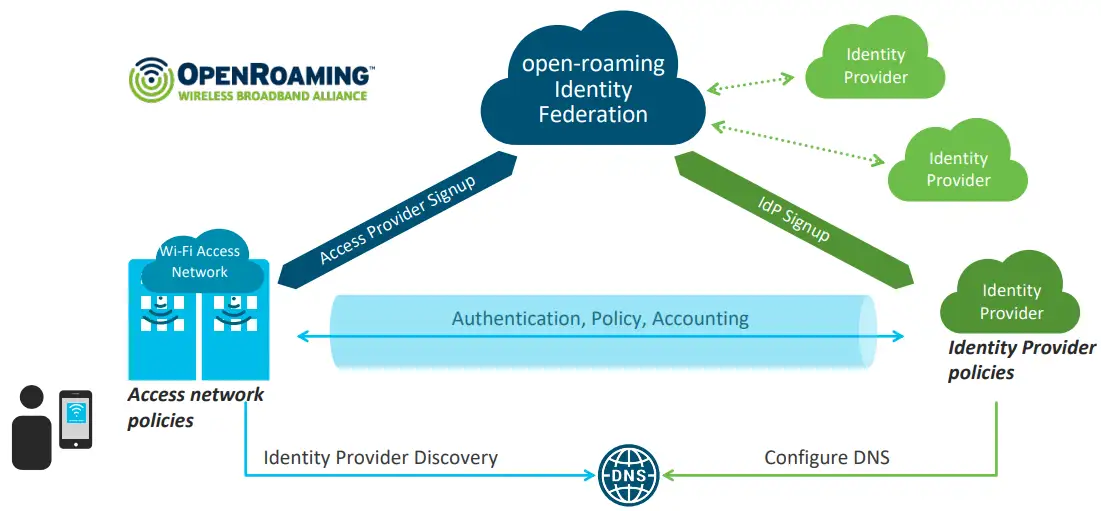
We successfully confirmed that chosen devices could seamlessly switch between two networks without any new authentication requirements.
To do this, two simulated Wi-Fi networks, SSID A and SSID B, were created. The devices were then registered with OpenRoaming, which enables a seamless and secure connection to Wi-Fi among a trusted network of roaming partners. The devices used included smartphones (iOS/Android), PCs (Windows/Mac), and IoT devices (Linux).
How OpenRoaming works:
Processing (Small Edge)
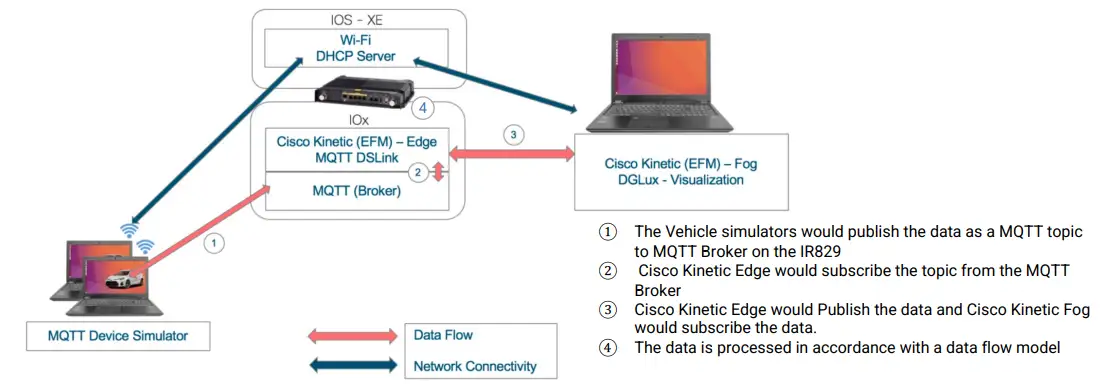
The PoC successfully demonstrated centralized control of edge computing instruction, data normalization, noise reduction, and data size footprint reduction by filtering and aggregating the data. To do this, a simulated automotive device was created, which captured the performance metrics of the edge computing device (as mentioned above, the automotive data was simulated using software, not actual automotive telemetry devices).
Processing (Large Edge)
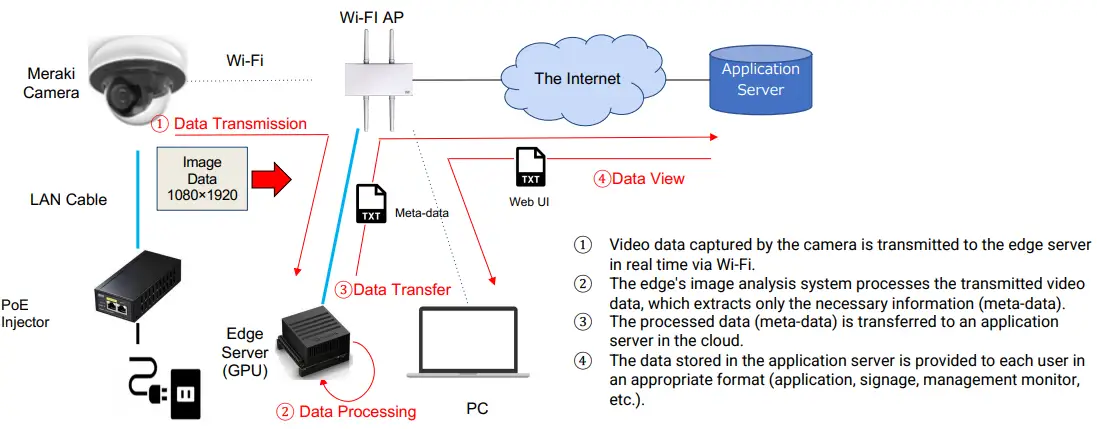
The PoC team successfully built a demonstration system for image analysis using AI at the edge. Since the effectiveness of converting video data to meta data for reducing data volume is obvious, the necessary conditions and performance for image analysis are being verified.
Next Steps
The team assumes that further pre-processing of data at the edge can improve load mitigation and energy savings benefits.
To confirm this, phase two will include a multi-edge validation to evaluate the end-to-end (E2E) reduction effectiveness (including network and other metrics), fault tolerance, prioritized use of renewable energy, and high performance. This will involve installing edge servers at roadside facilities and running a pilot program using actual vehicles.
We will also be testing the following use cases:
- Download regional and time-limited content services, such as data distribution with large volume data (e.g., HD maps, video information) and geo-fencing (e.g. time-sale advertising), provided via Wi-Fi and the edge.
- Connect to video streaming services to watch movies.
Ultimately, the plan is to develop and publish standard architecture and reference equipment configuration specifications that can be implemented in roadside infrastructure.
Become a Member
With collaboration among OEMs, MNOs, network/computing solutions, and app and service providers, the AECC can help with the progression of developing high-value digital services across the connected vehicle ecosystem.