Green Computing:
Sustainable Compute Infrastructure for the Mobility AI Era
Background
and Motivation
Training AI for automated driving (AD) and advanced driver-assistance systems (ADAS) runs on large GPU clusters that stay occupied for long periods. As models and vehicle data volumes grow, so does the GPU capacity required — and with it the electrical power those GPUs draw and the specialized data-center facilities, including advanced cooling, needed to keep them running. Securing that power and limiting its environmental impact is becoming an increasingly important industry consideration.
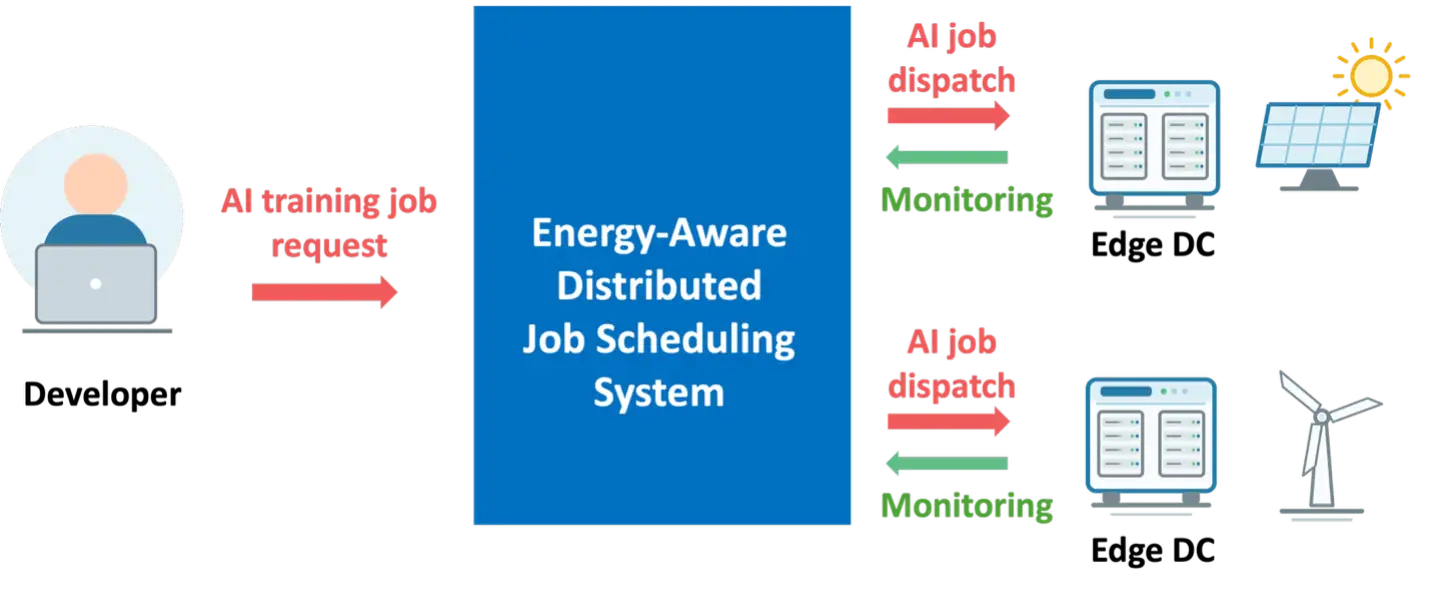
Distributed compute infrastructure located near renewable energy sources may offer a more sustainable approach — sometimes described as moving data to available energy rather than transporting energy to centralized compute. Practical deployment, however, requires coordinated solutions across workload scheduling, data placement, networking, cooling, reliability, and energy availability.
Two linked sets of questions follow. The first concerns how to build and operate a data center coupled directly to renewable generation — siting, cooling method, and the service-quality levels such a site can realistically commit to. The second, and the more consequential one, concerns how a set of such sites is operated together. Renewable output varies by site, by weather, and by time of day, so the essential capability is to flex AI processing — and the vehicle data it depends on — across sites in step with where green power is actually available.
AECC’s Role
Renewable-powered AI training infrastructure is a cross-industry challenge that no single company or sector can solve alone. AECC brings automotive, telecommunications, cloud, data-center, and energy stakeholders together to define requirements, distill shared design principles, and validate practical approaches through publications and PoCs.
Key Initiative
Green Computing SIG brings together experts from these industries to turn that agenda into concrete technical work. Its current activities are
- Define requirements and design principles for renewable-powered compute infrastructure
- Validate distributed workload scheduling using energy and performance data
- Develop approaches for vehicle-data placement and movement across distributed compute sites
Related PoCs,
Publications,
and Events
Green Computing SIG builds on earlier AECC PoC work and extends it to mobility AI training workloads, which carry far higher computational load and data volume.
- Wi-Fi Data Offloading and Edge Computing for Greener Mobility Services — PoC — https://aecc.org/proof-of-concepts/entry/936/
- Optimal Edge Selection for Realizing Digital Twins and Green Energy Utilization — PoC — https://aecc.org/proof-of-concepts/entry/1272/
Get Involved
Green Computing SIG welcomes companies who want to help shape sustainable compute infrastructure for mobility AI — whether by contributing to Task Groups, sharing requirements, or simply learning more about AECC’s work. To explore membership and participation, contact [email protected].