
Premium Communication Services Utilizing Telco APIs
Download PDFAbstract
Offering different service tiers at varying price points is a widely used business model across industries — one that also has excellent potential for connected vehicle services. The key question becomes how to make this concept work in real-world conditions.
This proof of concept (PoC) demonstrates how premium service users could dynamically switch between dedicated and priority communication services using telecommunications application programming interfaces (telco APIs). This would validate the architecture for seamless service transitions based on real-time network conditions, proposed by AECC’s Working Group 2 (Technical Solutions).
An important consideration for this PoC is the maintenance of a baseline level of reliable, high-quality connectivity, including during transitions. This is essential for all connected vehicle services, particularly for any safety-critical services such as navigation and autonomous driving.
This PoC presents an end-to-end solution that optimizes network resources through network slicing, a key 5G capability that creates virtual, dedicated segments within a network to meet specific performance needs. In this case, a dedicated slice — offering higher-speed, low-latency access — is established for automakers providing premium services. When necessary, vehicle traffic is dynamically switched from the shared enhanced mobile broadband (eMBB) slice for general 5G users to the dedicated slice using Telco APIs. The results confirm that applications can dynamically adjust quality of service (QoS) parameters to maintain performance, even in congested network environments.

Figure 1: Technical overview for this PoC, showing the end-to-end architecture.
Business Strategy
People spend several hours every day commuting between work and home, time that most feel is wasted. But what if that time could be spent productively? For business professionals — especially executives — high-quality video conferencing is an essential part of productivity. Many would be willing to invest in enhanced connectivity to ensure uninterrupted, high-resolution meetings on the go.
This PoC demonstrates how premium connectivity can be dynamically allocated based on a traveler’s route, providing a seamless and reliable experience. By optimizing network access in real time, the solution ensures that users receive the bandwidth and stability needed for critical communications, regardless of location or network congestion.
Objective
The goal of this PoC is to demonstrate how users can seamlessly access high-quality video conferencing through dynamically allocated premium connectivity based on their travel route. This PoC aims to optimize network access in real time using telco APIs , ensuring reliable bandwidth and stability for critical communications.
Scenario
In this PoC, a driver uses an in-car navigation system equipped with a service area API to select a route based on communication quality, ensuring a seamless high-bandwidth experience while traveling.

Figure 2: User interface for the in-car navigation system.
Here’s how it works:
- Route selection based on connectivity: Before starting the journey, the driver searches for a destination within the navigation system. Using the Service Area API, the system evaluates different route options, factoring in network coverage and premium service availability. The interface displays multiple route candidates, each showing distance, estimated travel time, and premium connectivity levels, allowing the user to make an informed decision.
- Executing the QoD API for optimized connectivity: Before departure, the driver activates the quality on demand (QoD) API, which dynamically provisions and prioritizes network resources along the selected route. This ensures the highest possible connectivity quality throughout the journey.
- Seamless high-quality application usage on the move: As the vehicle follows the selected route, the driver or passengers can engage in bandwidth-intensive applications, such as high-quality video conferencing, without experiencing disruptions. The system continuously manages connectivity based on real-time network conditions, optimizing performance even in congested areas.
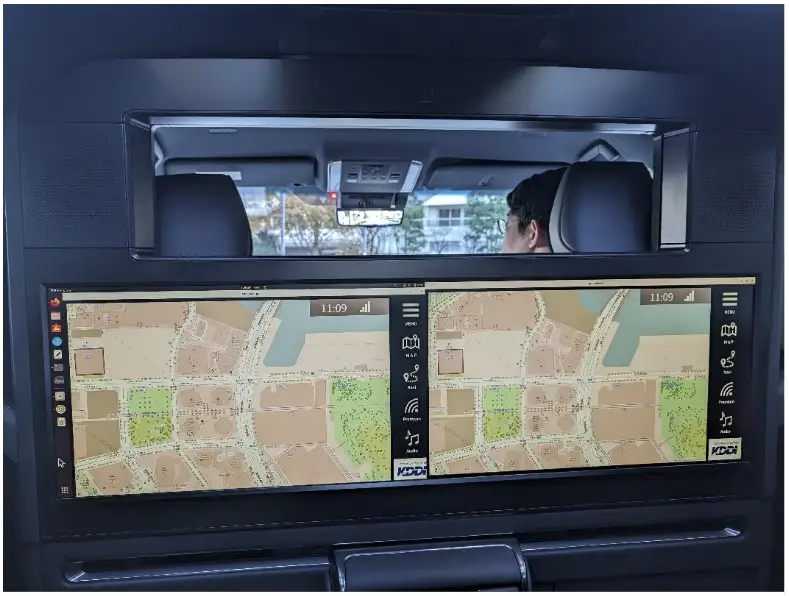
Figure 3: System deployed in a vehicle.
Under the Hood: the Technical Processes
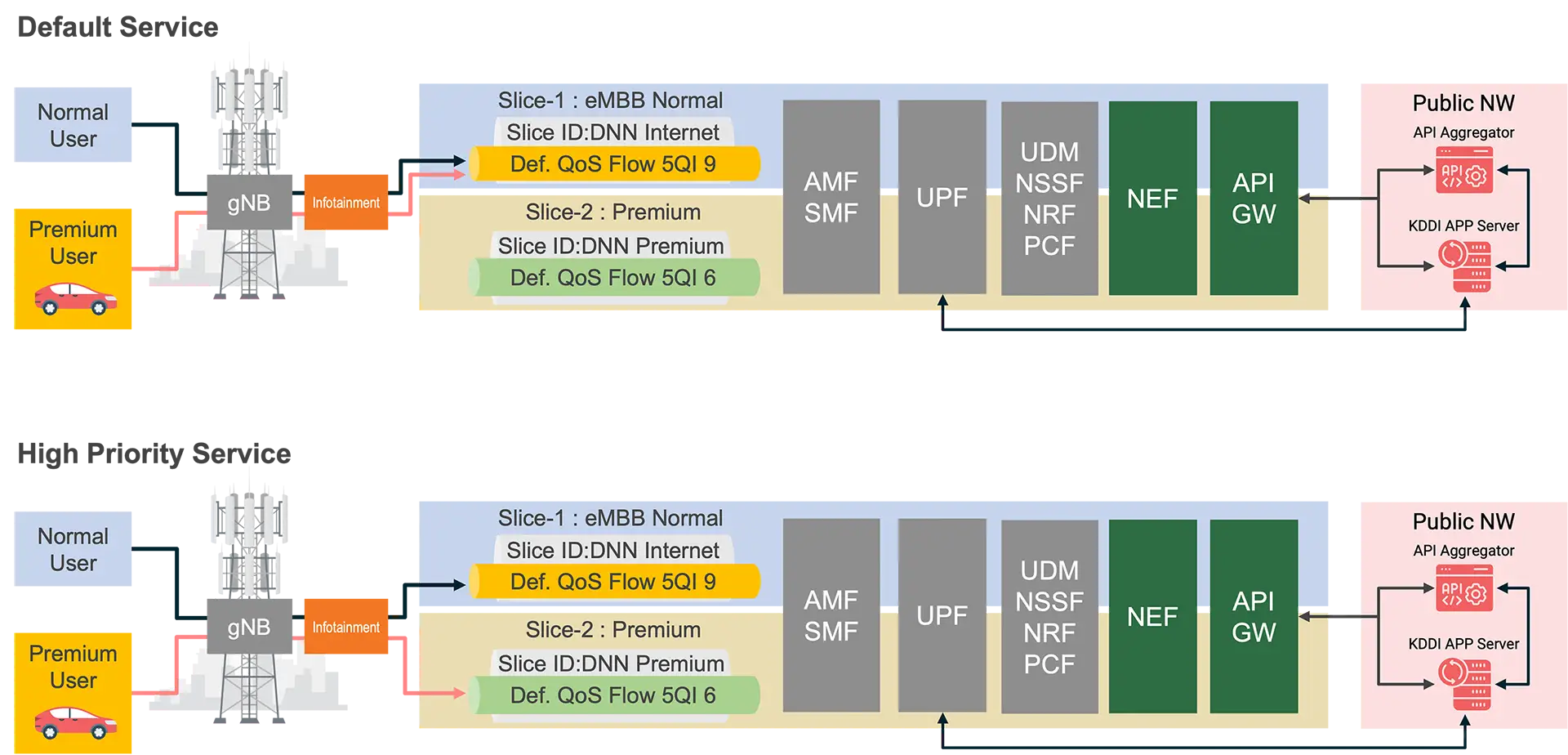
Figure 4: QoS system configuration with QoD API. In both diagrams, the overall architecture is the same. However, in the upper diagram, communication between the regular Toyota subscriber and the Toyota premium user goes through network slice 1, while in the lower diagram, which shows when the priority service is available, communication for the Toyota premium user goes through network slice 2.
The end-to-end process for this field trial was as follows.
- Triggering QoD services:
- When using high priority service, the application server sends a request to the API aggregator on Amazon’s cloud servers, AWS.
- The API aggregator receives the QoD request via HTTPS API calls using CAMARA QoD APIs.
- The API aggregator then forwards the request to the Ericsson Yokohama Lab Central 5GC Core for processing.
- Network and infrastructure components activation:
- The request passes through the DCGW (firewall), which routes the request to the 5G Core components.
- The 5G Core consists of several key elements:
- NEF (network exposure function) – Ensures external applications can interact with the 5G network.
- UDM (unified data management) – Manages user authentication and subscriber data.
- PCF (policy control function) – Assigns quality policies based on the request.
- NRF (network repository function) & NSSF (network slice selection function) – Allocates resources dynamically.
- Application-level integration:
- In the Ericsson Yokohama Lab, the network infrastructure interacts with the testbed setup, which includes:
- BBU (baseband unit) – Handles radio processing.
- DCGW (data center gateway) – Connects different network domains.
- LPG (local packet gateway) – Manages data flow between core and edge networks.
- In the Ericsson Yokohama Lab, the network infrastructure interacts with the testbed setup, which includes:
- Outdoor and vehicle integration:
- Toyota vehicles equipped with infotainment systems and application front ends (APP-FE) request network resources.
- Data transmission happens via an Ethernet interface connecting to a next-gen base station (gNB).
- The gNB forwards the request to the 5G network, ensuring proper service allocation.
- QoD API-based traffic differentiation:
- The system determines the service level based on the QoD API request.
- Two service categories are defined:
- Default service (lower priority): eMBB (enhanced Mobile Broadband) users and premium users utilize Slice 1 (DNN Internet) with QoS Flow 5QI 9.
- High priority service: Premium users are switched to Slice 2 (DNN Premium) with QoS Flow 5QI 6 to maintain superior connectivity.
- Data flow and API response:
- The Application server manages application requests in real time.
- The NEF and API gateway (APIGW) interact with the API aggregator in the public network.
- The system continuously adjusts network slicing and QoS policies based on user demand.
This workflow ensures seamless QoS management across different user categories, dynamically optimizing Toyota vehicle connectivity and other application requirements.
Results
This PoC demonstrates how intelligent route selection and dynamic network resource allocation can enhance the experience of business travelers and other users who rely on uninterrupted, high-quality connectivity while in transit. A high-quality conference system for in-car use can be offered, contributing to a better user experience.
Figure 5: Video call in progress.
Next Steps
The engineering team plans to validate new telco APIs and explore enhanced use cases by combining more APIs.
With collaboration among OEMs, MNOs, network/computing solutions, and app and service providers, the AECC can help with the progression of developing high-value digital services across the connected vehicle ecosystem.